
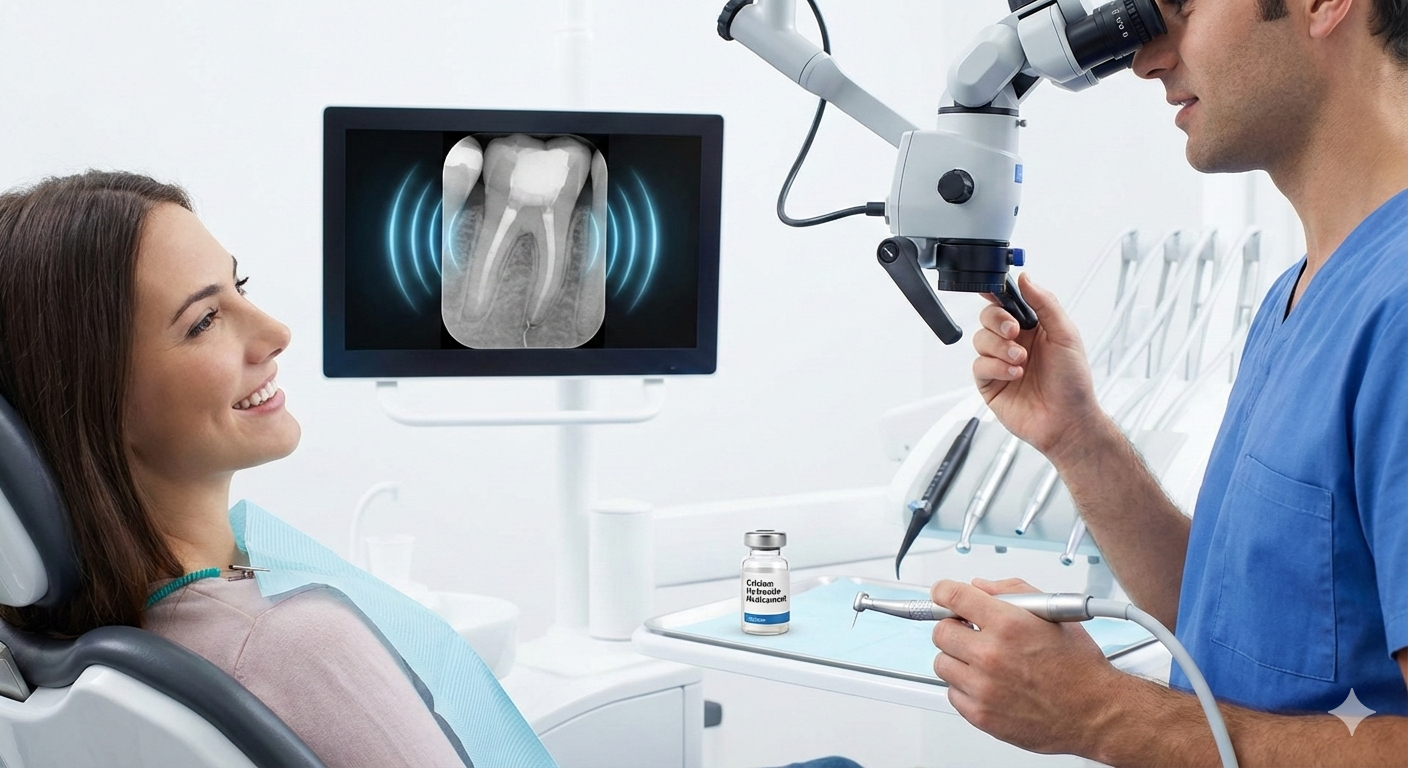
If there is one phrase in dentistry that triggers anxiety, it is "Root Canal." For decades, the procedure has been associated with pain and uncertainty. But here is the truth the internet might not tell you immediately: Modern root canal treatment (RCT) is nothing like the stories from the past.
The difference lies in technology. It is no longer just about "drilling and filling." Today, success in root canal treatment is driven by advanced disinfection protocols—specifically modern ultrasonic irrigation and the strategic use of proper intracanal medicaments.
This article dives into how these two "invisible heroes" ensure your tooth stays healthy for a lifetime.
The Hidden Challenge: Why Brushing Isn't Enough
To understand why modern technology is necessary, we have to look inside the tooth.
A root canal isn't a simple, straight pipe. It is a complex web of tiny tunnels, curves, and microscopic offshoots (called isthmuses and lateral canals).
The Problem:
Traditional files and needles can clean the main tunnel, but they often miss bacteria hiding in these microscopic crevices.
The Consequence:
If bacteria remain, the infection can return, leading to root canal failure.
This is where modern science steps in.
1. The Game Changer: Modern Ultrasonic Irrigation
Imagine trying to clean a narrow glass bottle. You can scrub the sides with a brush, but you can't reach the bottom corners. Now, imagine putting that bottle in a high-tech dishwasher that uses high-speed water vibrations to blast dirt out of every corner.
That is exactly what Passive Ultrasonic Irrigation (PUI) does for your tooth.
How Ultrasonic Irrigation Works
Instead of just flushing the tooth with a syringe (which only cleans about 65% of the canal), endodontists use an ultrasonic tip. This tip vibrates at a high frequency (around 30,000 times per second), creating two powerful effects:
- Acoustic Streaming: Rapid movement of the fluid that dislodges debris.
- Cavitation: The formation of bubbles that implode, blasting away the "smear layer" (a film of bacteria and debris) from the canal walls.
The Benefits for the Patient
- Higher Success Rate: Studies show ultrasonic activation can reduce bacterial load by 82% to 98% compared to traditional methods.
- Less Post-Op Pain: By cleaning more effectively without aggressive filing, patients often experience significantly less discomfort in the first 48 hours.
- Preservation of Tooth Structure: Because the water does the cleaning, the dentist doesn't have to drill away as much healthy tooth structure.
Key Takeaway:
If your dentist uses ultrasonic irrigation, they aren't just cleaning your tooth—they are sterilizing it at a microscopic level.
2. The Guardian: Proper Intracanal Medicament
Sometimes, a root canal requires two visits. While this might seem inconvenient, it is actually a strategic move to ensure long-term success.
Between appointments, the dentist places a medicine inside the tooth. This is the intracanal medicament.
The Gold Standard: Calcium Hydroxide
The most effective and widely used medicament is Calcium Hydroxide (Ca(OH)₂). It acts as a "time-release" disinfectant.
- pH Power: It has a very high pH (around 12.5), creating an alkaline environment where bacteria cannot survive.
- Dissolving the "Bad Stuff": It actively dissolves remaining organic tissue and neutralizes bacterial toxins (endotoxins) that cause inflammation in the bone.
- Healing Promotion: It encourages the bone around the root to begin healing even before the final filling is placed.
Why not finish in one visit?
For complex infections, single-visit root canals may not allow enough time for the body to heal or for the medicine to kill stubborn bacteria like Enterococcus faecalis. A 7-day application of an intracanal medicament can be the difference between a tooth that heals perfectly and one that flares up later.
People Also Ask (FAQ)
Q: Is ultrasonic cleaning better for root canals?
A: Yes. Ultrasonic irrigation is superior to traditional needle irrigation because it activates the cleaning solution, forcing it into microscopic lateral canals and isthmuses that manual tools cannot reach. This significantly lowers the risk of reinfection.
Q: Why do dentists put medicine inside the root canal?
A: Dentists use intracanal medicaments like calcium hydroxide to kill resistant bacteria and dissolve tissue that instruments missed. This "medication phase" (usually lasting one week) dramatically increases the success rate of root canal treatment in infected teeth.
Q: What is the success rate of modern root canal treatment?
A: With the use of dental microscopes, ultrasonic irrigation, and proper medicaments, modern endodontic treatment has a success rate ranging between 85% and 97%.
Q: Does ultrasonic irrigation hurt?
A: No. The procedure is performed under local anesthesia. In fact, patients treated with ultrasonic protocols often report less postoperative pain because the technique is gentler on the tooth structure while being tough on bacteria.
The Verdict
Success in root canal treatment isn't luck; it's protocol.
When you choose a dentist or endodontist who utilizes modern ultrasonic irrigation and understands the biology of intracanal medicaments, you are investing in the long-term survival of your natural tooth.
Are you experiencing tooth pain or sensitivity?
Don't fear the procedure. Schedule a consultation with us today to see how our advanced technology makes saving your smile comfortable and predictable.
Schedule a Consultation